
The journey of teaching my kids to read began very early on. It started with exposing them to books, as I discuss in part 1. We read together all the time and they knew what reading looked like by watching me do it. In addition to reading lots of books, I would sing the alphabet song to them often and we would read abc books.

Singing and listening to different variations of the alphabet song and reading abc books together, helped familiarize them with the alphabet. Through repetition they started to sing the alphabet song on their own, in their own cute way, with the letters all jumbled together.
Once my children reached the developmental stage of being able to point to specific things I named, as well as attempting to imitate my movements and words when prompted, we began focusing on learning individual letter names and sounds: not just the alphabet as a whole.
To teach the names and sounds of the letters, I concentrated on two things: the alphabet movement song and letter games. These two things were staples in teaching my kids the name and sounds of the letters. This, in turn, got them ready for our actual reading lessons, which I discuss in part 3. Let’s dive into the alphabet movement song and letter games..
The Alphabet Movement Song
When singing this version of the alphabet song, your child is hearing, singing, seeing, and acting out a movement for each letter. All of these learning modalities help them internalize and memorize the names and sounds of each letter through association and repetition.
I made up a simple movement for each letter that went along with the picture. We sang the alphabet song everyday. I would show the letter card when the song said the NAME of the letter and I would do the simple movement when the song said the SOUND of the letter.
I used this alphabet song by Learning Dynamics because it says the letter names as well as sounds. I used these alphabet display cards because they are large, they show the upper and lower case letter, and there is a picture that is next to each letter. These alphabet cards from Learning Dynamics are great as well because the pictures are simple. Plus, this set comes with the reading books we used for our reading lessons, which I cover in part 3.
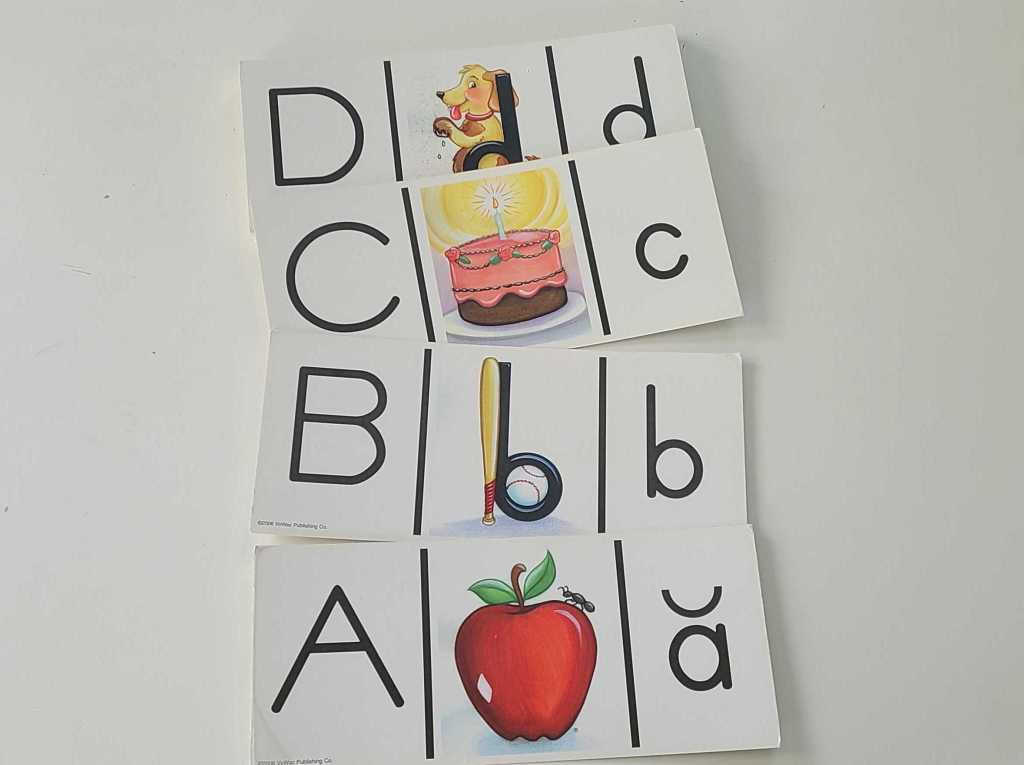
You don’t need this exact song or the same alphabet cards. I chose this song because it says the name AND sound each letter makes. It has a slower tempo than the traditional alphabet song. A slower tempo gives me enough time to show the letter card for each letter when the letter name is said and act out the movement when the letter sound is said. Any alphabet cards will do, as long as they have a picture with each letter that you can make up a simple movement to. Below is the list of the movements we made up for each letter, as a quick reference:
Each day, after we sang the alphabet song and did the movements for each letter, I would pick one letter to focus on. If the letter that day was ‘Aa’, I would show that letter card and talk about what the capital and lower case letter look like (Upper Case ‘A’: a triangle with legs, lower case ‘a’: a circle with a line on the side). Next, we would draw the upper and lower case ‘Aa’ with our finger in the air. While we drew it in the air, I would say how we were moving our finger (Upper case ‘A’: diagonal down, diagonal down, across. Lower Case ‘a’: a circle and a line). Then, I would tell a little story about the picture that matched our movement. Here are the stories I made for each letter:
alphabet display card and hear the letter sound
If you have different pictures on your letter cards and are not sure what movement to make, look at the picture on each card. If the picture shows an alligator for ‘Aa’, you can make a chomping movement with your arms. If the picture is a ball for ‘Bb’, you can make a dribbling movement with your hand. The goal is a simple movement that is easily associated with the picture, so your child can refer to the movement to help them remember the sound of the letter.
Letter Games
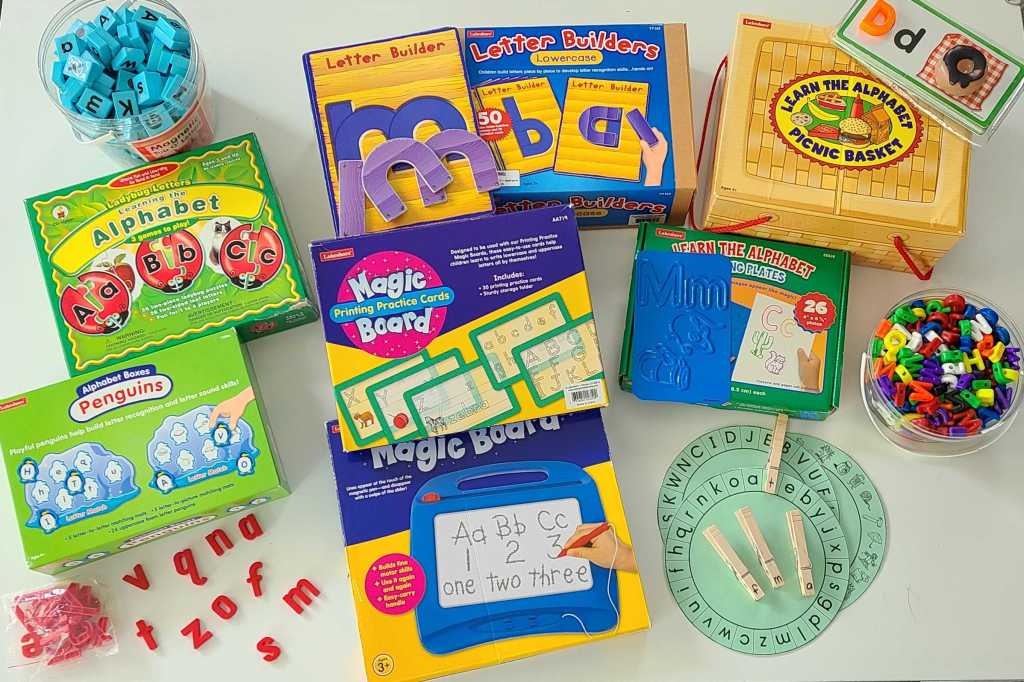
We played letter games almost everyday. Letter games can be played with magnet letters, alphabet puzzles, flash cards, letter beads, chalk, etc. The goal of these games is to familiarize your child with the letter names and sounds. When we are playing these games or when we are reading, I make it a point to act out the movements from our alphabet song while I say the sound of the letter we’re playing with or reading. This helps sooo much. If you do this often, your child will begin to show the movements for the letters themselves.
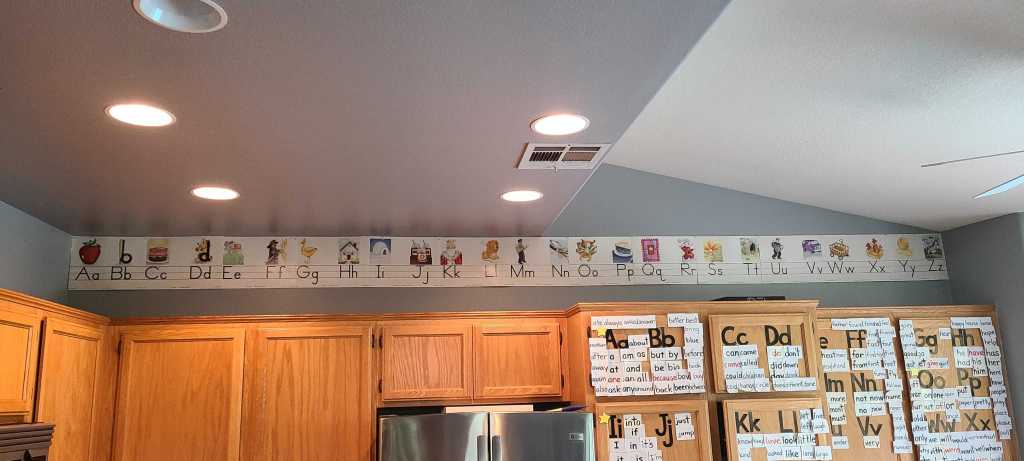
I hung my letter display above the cabinets in our kitchen since the kitchen faces our living room, which is our homeschool space. They refer to it for games, reading, writing, etc. It’s super useful!
If teaching all twenty-six letters at once sounds overwhelming, focus on three to five letters at a time. Once they can say the letter name/sound for those few letters in random order, move on to the next small set of letters. Each time they learn the name and sound of a letter, celebrate! Do a cheer! You can hang the letter they learned on your ‘celebration wall’ so they can see their growth while having a place to reference those letters when needed.
We had lots of fun learning the letters, here are some of our favorite letter games:
Fly Swatter-
This is a fly swatter game my kids love. Just switch the sight word cards with as many letter cards you want to focus on, to make it a letter game. Say the name and/or sound of the letter slowly and it’s their job to swat the letter named
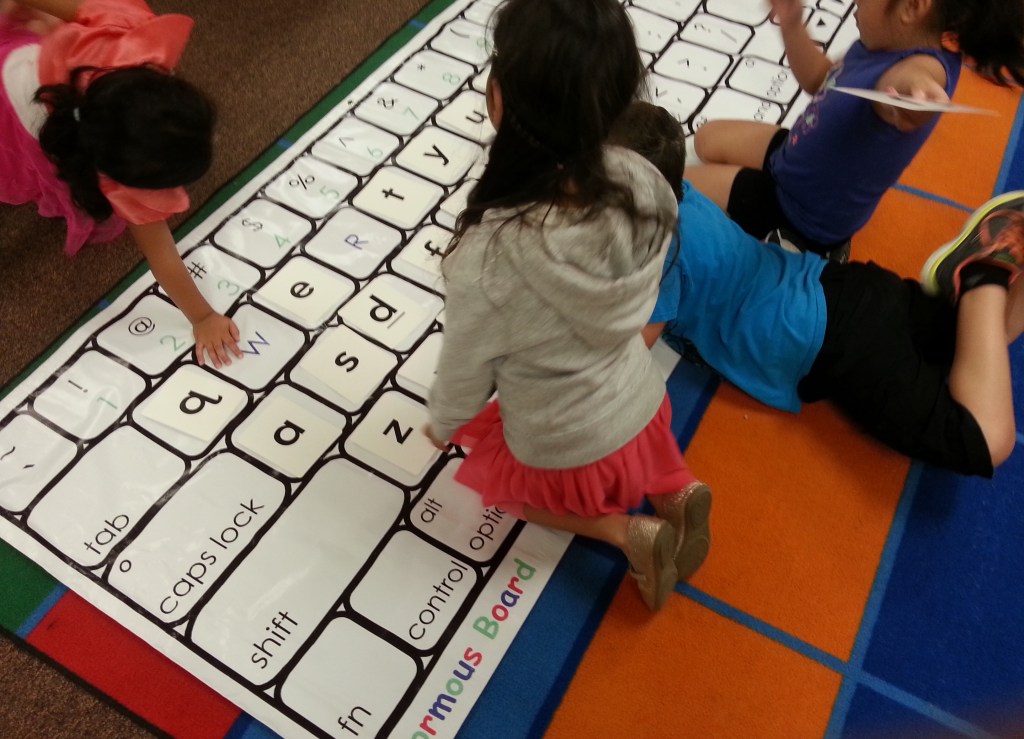
Normous Board-
I created a huge computer keyboard called a Normous Board. One of the popular letter games is matching lower case flash cards with the upper case keys. Another is jumping on the letter name and sound that is called out
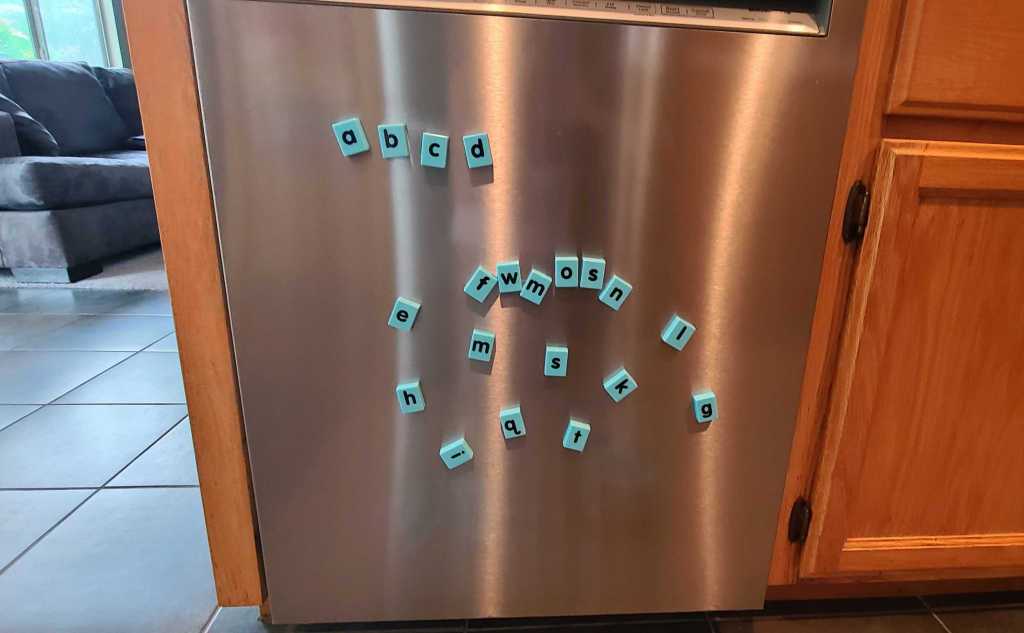
Magnet Letters-
You can play a letter magnet game by putting a few letters on your fridge or dishwasher. Ask your child to point to a specific letter name and or letter sound. Another variation of this game is asking for a specific letter and then putting the letters in abc order (I would have the alphabet display up for this one, so we could reference it together)
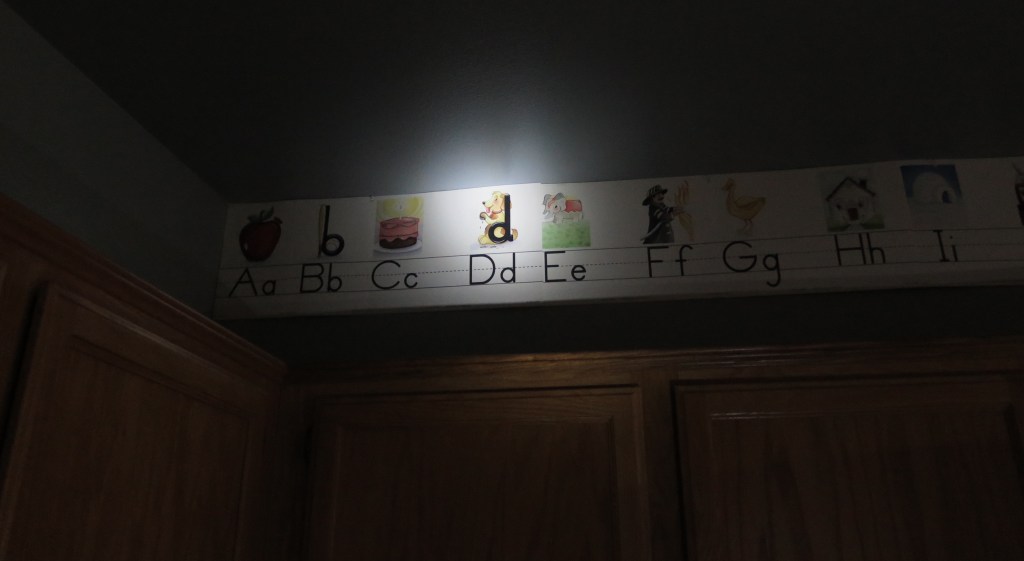
Flash Light Letters-
Make the room dark and ask your child to point to the letter you name using a flash light. You can also play this game with a laser pen
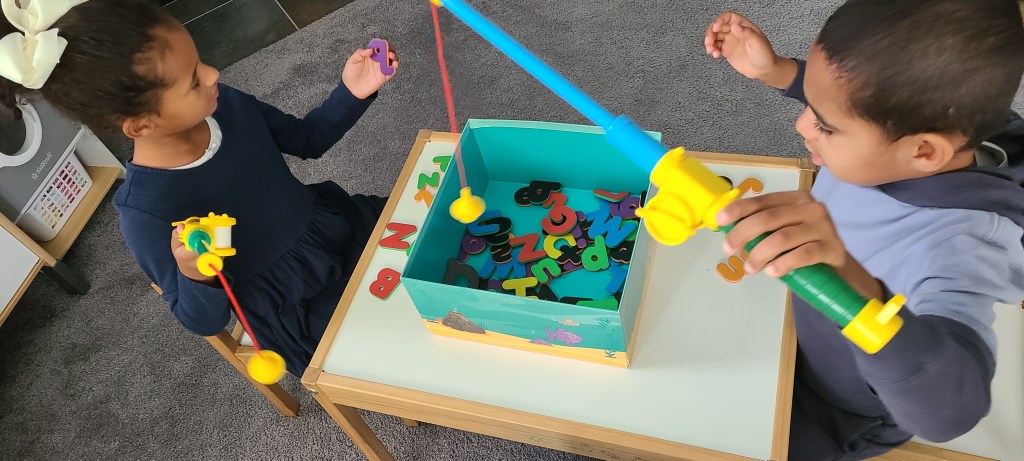
Fishing for letters-
Dump magnet letters in a box and give the kids a magnet or a slotted spoon to help fish out a letter. When they catch a ‘fish’, we say its name and sound
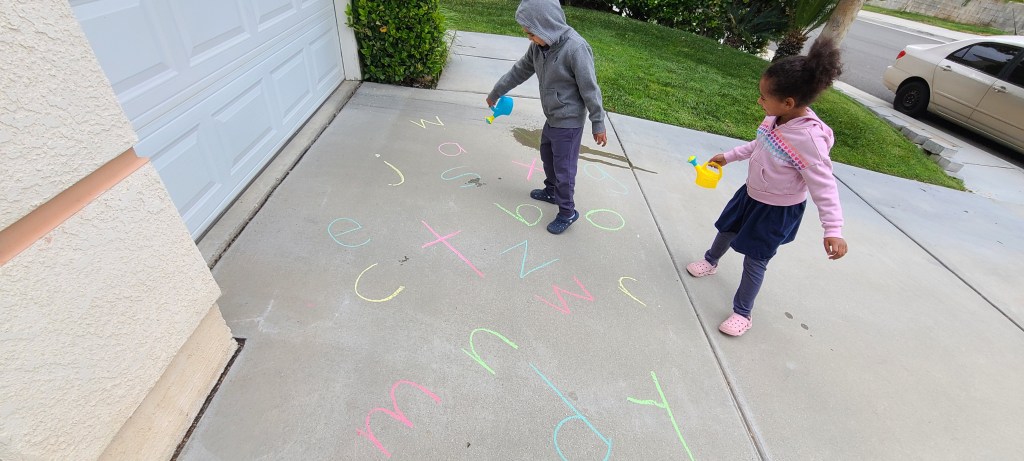
Disappearing Chalk-
Write letters with chalk on the floor. Have your child spray water over the letter you name with a watering can, spray bottle, or water gun
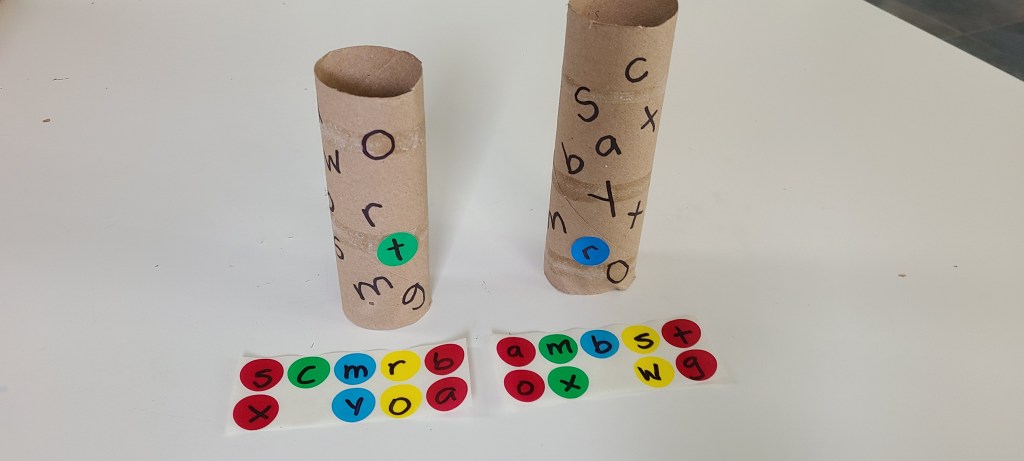
On a Roll, Letters-
Write some letters with a sharpie onto a paper tube. Write the same letters on colorful circle stickers. Ask your child to put a sticker on the matching letter on the tube
For more letter recognition games, check out Pinterest. There are sooo many super cute and fun ideas, like ABC Parking Lot!
When you are teaching the letter names/sounds, you will feel like you sang and acted out the movements for the alphabet song a million times. But one day, they will know all their letters and sounds and will be ready to start blending sounds together to read. And you’ll know it was because of you and your child’s hard work and consistency. This is a magical time in your child’s life, remember to enjoy the whole process: from A-Z.
 Peachy Teachy
Leave a comment